The Navigator's Edge: Building an Index a Stranger Can Follow Through a UK Bundle
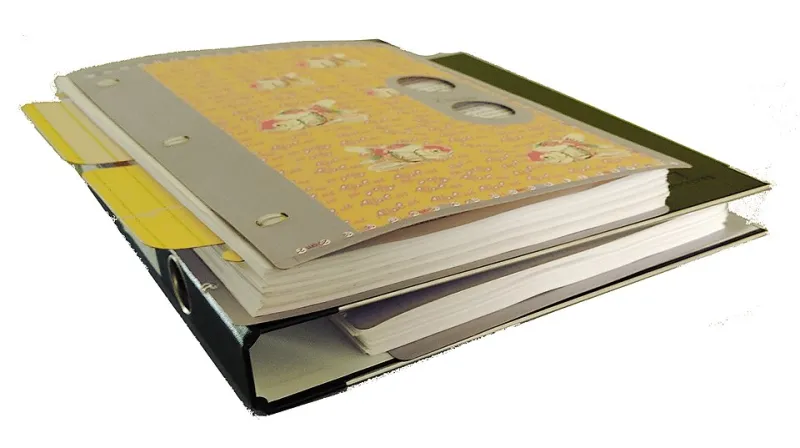
Photo: Jacek, CC BY-SA 4.0, via Wikimedia Commons
The reader you have not met
A bundle assembled in a UK office is rarely read by the person who assembled it. It is opened by a fee earner picking up a file at short notice, a client attending a meeting, an insurer's handler, an usher, a scanning operator working through a backlog, or a colleague covering a matter during leave. Each of these readers arrives cold. They have no memory of the order in which the papers were gathered, and no intuition about where a particular schedule might sit.
Divider tabs are the only part of the bundle designed exclusively for that reader. Everything else was written for a purpose that predates collation. The tabs exist to answer a single question, repeatedly and quickly: where am I, and where is the thing I need next?
Treating indexing as decoration produces bundles that look ordered but cannot be navigated. Treating it as a navigation system produces bundles that can be handed to a stranger without a covering explanation.
Order before colour
The sequence of tabs should follow the sequence in which the reader will need the material, not the sequence in which it was collected. Those two orders are frequently different. Correspondence often accumulates in date order because that is how it arrives, but a reader usually wants the agreement, then the schedules, then the correspondence that varies it, then the evidence of performance. Date order is a property of the file; reading order is a property of the task.
A useful discipline is to write out the tab sequence as a plain list before any tabs are printed, and to test it against three questions. Can a reader find the operative document in under thirty seconds? Can a reader move from a factual assertion to its supporting evidence without returning to the index? Does the sequence still make sense if a section is removed at the last moment?
The last question matters because sections are removed at the last moment. A sequence built on running numbers will break when a section is pulled; a sequence built on a small number of stable top-level parts, with sub-tabs that can be relettered, will survive.
Labels that read as instructions
The label on a tab has roughly two seconds of attention available. It should be a short noun phrase that names the section unambiguously, consistent in grammatical form with its neighbours. If Tab B is "Witness Statements", Tab C should not be "Bundle of correspondence relating to the variation". It should be "Correspondence".
Avoid abbreviations that are local to the matter. Initials that mean something to the assembling team often mean nothing to a reader three months later. Where an abbreviation is unavoidable because the full term is unwieldy, define it once on the index page and then use it consistently.
Print labels rather than writing them. Handwritten tabs are legible to the writer and increasingly less so to everyone else, and they scan badly. A consistent typeface, a consistent size and a consistent position on the tab all reduce the effort required to scan a row of tabs at a glance.
The index page as a working tool
The index page is often produced as a formality, listing section titles without page numbers. It should instead be the most useful single sheet in the bundle. At minimum it should carry, for each tab, the letter or number, the section title, the page range, and the date range of the material within. A reader who knows only that they want correspondence from March should be able to get there without opening anything else.
Where the bundle will be referenced in correspondence or at a hearing, add a column for the reference format used in the matter, so that everyone cites the same way. Ambiguity about whether "page 84" means page 84 of the bundle or page 84 of the section is a small problem that consumes a disproportionate amount of time.
Print the index on the same stock as the rest of the bundle and place it in the same position in every copy. If the bundle is bound, the index sits before Tab A and is paginated with the preliminaries so that it can be cited.
Cross-references that hold under pressure
Cross-references should point to a tab and a page, not to a paragraph number alone. "See Tab D, page 112" is robust; "see paragraph 14" depends on the reader sharing the assembler's mental map of the document.
Keep the reference format short and use it identically throughout. Where a document appears in more than one place, say so on the index page rather than leaving the reader to discover the duplication and wonder whether one copy is different. Duplication that is signposted is a convenience; duplication that is not is a trap.
Surviving the photocopier
Bundles are copied. Tabs that extended beyond the trimmed edge of the page will be clipped, folded or lost in the copier. Tabs that sit flush within the A4 footprint, printed on the page itself or on a divider trimmed to the same size, reproduce reliably.
Contrast is the other variable. Pale pastel tabs disappear on mono copiers; very dark tabs produce shadowing along the binding edge that can obscure the first line of text on the facing page. Mid-tone colours with dark print are the safer choice where colour is used at all.
Colour should never be the only carrier of meaning. A reader with a mono copy, a colour-blind reader and a scanner all receive the same bundle, and only one of them sees the distinction between the blue section and the green one. Use colour to reinforce a distinction that is already carried by the tab letter and the section title.
Surviving the scanner
The scanning operator is a reader too, and one with less patience than most. Labels should be horizontal where possible, or rotated consistently if vertical tabs are used, so that optical character recognition captures them at a predictable angle. Handwritten annotations on tabs are frequently lost.
Where the bundle will be scanned section by section, the tab letters themselves become the filenames. A section labelled "C" scans cleanly to a file named for the section title; a section labelled with a symbol or a colour alone does not. Deciding the naming convention at the tab design stage avoids a second pass through the document later.
A short checklist
- Tab order follows reading order, not accumulation order.
- Every label is a printed noun phrase, consistent in form with its neighbours.
- The index page carries tab, title, page range and date range.
- Cross-references cite tab and page, not paragraph alone.
- Tabs sit within the trimmed page footprint.
- Colour reinforces meaning but never carries it alone.
- Labels are horizontal or consistently rotated, and machine-readable.
None of these rules is expensive. Together they convert a stack of paper into something a stranger can use, which is the only test an index ultimately has to pass.